
Most people discover the Feldenkrais Method® because they want something physical to improve. Less pain. Easier movement. Better balance. More comfortable riding.
But the changes don't necessarily stop there.
In this episode, Mary shares a personal story about chronic hip pain, an uncomfortable ph...
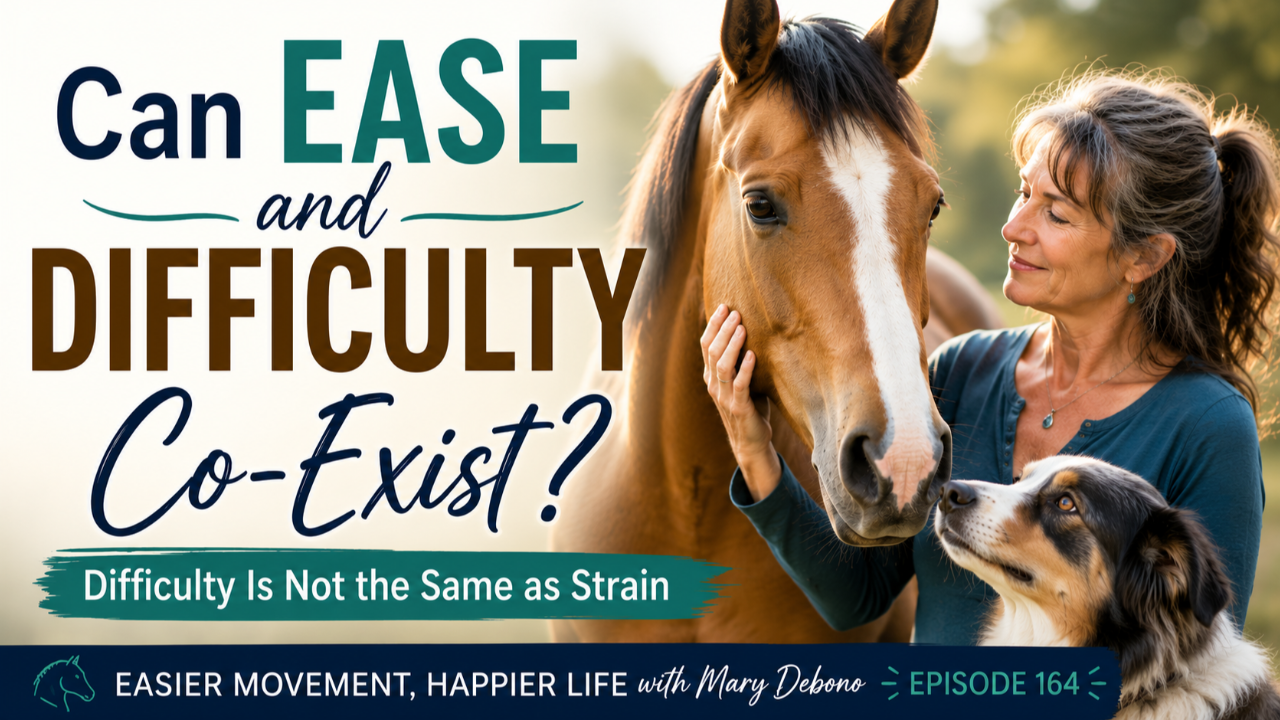
We often assume that difficulty and ease are opposites. If something feels challenging, we may push harder, tense up, judge ourselves, or avoid it altogether.
But difficulty is not the same as strain.
In this episode, Mary explores how a challenging experience can still include ease, curiosity, co...
What do you believe about your body, and is it true?
So many of us carry beliefs about our movement that we've never questioned, such as “I'm just not coordinated. I've always been stiff. My family all has bad backs. Of course things hurt more as I get older.”
These beliefs can feel like settled f...
There's a reason the Feldenkrais MethodⓇ asks you to move slowly and keep things small, at least at first. It's not about being cautious or holding back. It's about creating the conditions your nervous system needs to actually learn.
In this episode, Mary Debono breaks down one of the most foundati...
Autopilot is efficient, until it isn't. Most of us move through our days holding unnecessary tension, shortchanging our breath, and repeating patterns that work against us. Our horses and dogs do the same.
But there's one concept that can begin to shift all of it: slow is smooth, smooth is fast.
I...
Trying to “fix” stiffness, crookedness, or other movement issues often creates more guarding. In this episode, learn why physically supporting what your horse already does can help the nervous system feel safe, release habitual tension, improve movement, and deepen trust.
Applying this concept can...
What if your strong desire to help your dog is making it harder to help them?
It sounds counterintuitive, but when we become attached to a specific outcome, we often bring hidden effort, worry, and mental rigidity into the interaction.
And your dog feels all of it.
In this episode, I explore why ...
If you've spent any time in the horse world, you've probably been taught to watch for releases — the yawning, blinking, eye-rolling, and head-dropping that signal your horse is relaxing. But what if chasing those moments is actually getting in your way?
In this episode, Mary digs into why relaxatio...
What if the starting point for real change wasn't finding what's wrong, but finding what's already right?
In this episode, Mary Debono reflects on a critique of self-help culture by author Tim Ferriss, who observed that to continually improve yourself, you must continually locate the ways you ar...
There's an important distinction in movement education between effort and strain, and understanding it can change how you think about your own body and your horse or dog's soundness.
In this episode, Mary Debono breaks down what healthy effort looks like: energy directed toward what you want to ach...
In this episode, Mary Debono invites you to reconsider how you approach challenges, whether they show up in your own body, your horse, or your dog. When we label something a problem, we tend to reach for the same strategies that created it in the first place. That usually leads to temporary relief, ...
What if the key to better learning — for you and for your animals — was already built into the nervous system?
In this episode, Mary explores neuroplasticity: the nervous system's remarkable capacity to adapt, reorganize, and discover new possibilities. Drawing on the foundational work of Dr. Moshe...
